I’m writing this from home, in the middle of lockdown. The lifts are stopped, the season ended early, and like everybody else I’ve had a lot of time to sit and think. So I keep going back to February, to a trip I had no idea at the time how lucky we were to take.
This was the year I got my first Ikon Pass. That pass felt like a door opening. All of a sudden places I’d only seen in ski films were on the table, and the biggest one on my list was Jackson Hole. I’d been working hard on my riding, pushing into steeper terrain, feeling like I was finally stepping up to the next level. I wanted to test that somewhere real.
What I got instead was a lesson in how much I didn’t know. Not a bad lesson. A good one. The kind that makes you love something more.
Leaving in a storm
We left Denver in a snowstorm. Not the best way to start a road trip, but if you’re headed to Jackson Hole in the winter, you take the weather you get.
The plan was always to split the drive. We pushed north and stopped in Casper for the night, which turned out to be the smartest decision of the whole trip. The next morning I-80 was closed for wind, which happens more often than anyone who hasn’t driven across southern Wyoming would believe. We’d already planned around it. Instead of the interstate, we took what people call the back road: west through Shoshoni and Riverton, then up through Dubois and over the pass into Grand Teton National Park.
Through the Wind River country
That route is a lot more protected than I-80, and it’s also just beautiful country. Past Riverton the highway runs through the Wind River Indian Reservation, home to the Eastern Shoshone and Northern Arapaho tribes and one of the largest reservations in the country. It’s wide open land with the Wind River Range off to the south, Crowheart Butte standing up on its own, and red rock that starts showing up as you get closer to Dubois. On a gray winter day it was quiet and huge, and I’d like to drive it again when we’re not watching the sky the whole time.
Over Togwotee Pass
Looking back, we probably should have been stopped in Dubois. We got through right before they closed the gate on Togwotee Pass, the 9,600-foot crossing of the Continental Divide between Dubois and Moran Junction. At the time it felt like luck. About twenty minutes later it didn’t.
The conditions up top were some of the most dangerous I’ve ever driven in. We couldn’t see the road. The only way to stay on it was the reflective markers along the shoulder, so we crept from one to the next, trusting that the next one would show up. Then every so often they’d just disappear. Anywhere there’s a pullout or parking area along the pass, the markers stop, and you’re left staring into white with nothing to aim at until they pick up again on the other side. Those stretches felt very long.
Home free, almost
On the Teton side of the pass things cleared up a lot. The snow eased off, we could see the pavement again, and we honestly thought the hard part was over.
Not quite. We got stopped at Moran Junction, right where the highway crosses the wetlands where the Buffalo Fork runs into the Snake River. The park closes the stretch of highway between Moran and Moose when the wind starts drifting snow across that open ground, and that’s what was happening. We sat there and waited.
It didn’t take long for them to open it back up. We fell in behind a snowplow and followed it across the wind-blown road, still icy, still slow, nobody in a hurry to pass anybody.
The mountains we never saw
Here’s the part that still makes me laugh. That whole drive south from Moran, the Grand Teton was right there off our right shoulder, along with the rest of the range. We had no idea. The fog was so thick and low that there was nothing out the window but gray. Some of the most famous mountains in the country, close enough to feel, and we didn’t see a thing.
We made it through. The Tetons would have to wait.
Not that mountain
Rolling into the town of Jackson, we saw ski runs cut right into the hillside above town and figured that had to be Jackson Hole Mountain Resort. Nope. That was Snow King Mountain, the locals’ Town Hill. It’s been around since 1936 and was the first ski area in Wyoming.
I’d always heard of it as the little beginner hill, but it sure doesn’t look like one from the street. It’s got about 1,571 feet of vertical, and a lot of it is steep, especially up top. I’d love to come back and spend a day on it someday.
But not this trip. I had bigger plans. I wanted to ride the tram to the top of Jackson Hole and stand at the lip of Corbet’s Couloir and look down. That was the whole point. I’d been picturing it for weeks.
The mountain, as it turned out, had its own ideas about that.
Waiting on the snow
By the time we finally got to the hotel we were wiped out. A long day of white knuckles will do that to you. There wasn’t anything left to do but wait for morning.
Our room looked right out at the slopes, so I did what any filmmaker would do. I set up a timelapse and let it run all night.
What surprised me was how busy the mountain is after dark. There were groomers working runs all night long, headlights crawling back and forth across the slopes, laying down corduroy for the morning crowd. It was kind of mesmerizing to watch.
But the runs we were after wouldn’t get touched. Nobody grooms that stuff. It just sits there under fresh snow until the powder hounds wake up and go get it.
Pad Thai in ranch country
Once we’d settled into the room we went out looking for food. Options around the resort base are pretty limited for the most part, but we stumbled onto Teton Thai, a little family-run place right there in the village. I know, I know. Seeking out Thai food in the middle of Wyoming ranching country sounds a little odd. We gave it a shot anyway.
The pad Thai was either really, really good, or I was tired enough that anything would have tasted amazing. I honestly can’t tell you which. If you go, report back and let me know.
Big Red
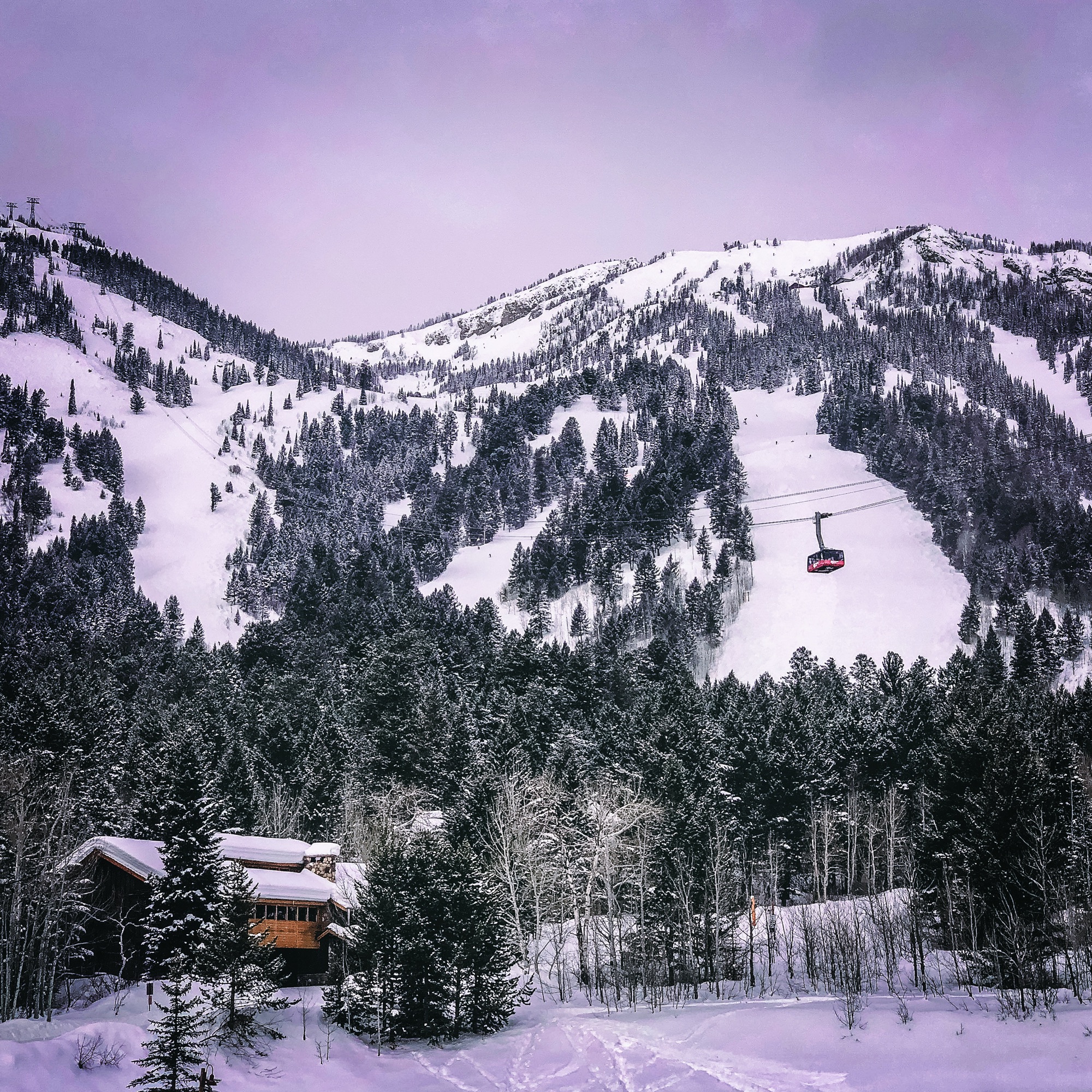
On the walk back to the hotel the snow was falling soft and quiet, and the tram building was right there in front of us. I’d never ridden anything like it. Big Red hauls 100 people at a time, all 4,139 vertical feet to the top of Rendezvous Mountain, in about nine minutes. You just don’t see trams like that at the ski areas back home in Colorado, and standing under it at night was something else.
Know before you go
What really got my attention as we got closer were the signs. They were everywhere. Avalanche danger. Know before you go. Warnings about what’s out past the boundary and what can happen in bounds too.
You don’t see that at the Disneyfied places in Colorado. Those resorts all but ignore the consequences of what’s outside the ropes, and they definitely don’t talk about danger on the mountain itself. Here it was right in your face, and it was clear they meant it.
It made me stop and think. Walking back to the room in the snow, looking up at that tram, my confidence took a hit. All the weeks of picturing myself standing over Corbet’s suddenly felt a little different.
The other thing in the air
That night gave me a few other things to think about, too.
This was February 2020, just a few weeks before the Covid lockdown, though none of us knew that was coming. We’d heard that gathering in big groups wasn’t a great idea, but it still felt like something happening somewhere else.
Earlier that day, back home, Vail’s Chair 5 had turned into a mess. Chair 5 is the only way out of Sun Up and Sun Down bowls, and when it backed up, the crowd at the bottom grew into something nobody had ever seen there before. People were packed shoulder to shoulder in one spot. Looking back, it’s hard not to think of that day as one of the places the virus got its start in Colorado.
Our friend Matt was one of the people who got sick before any of us really understood what was happening.
At the time, though, we were in a hotel room in Wyoming, watching a timelapse of groomers crawl across the slopes, thinking about powder. The rest of it hadn’t caught up to us yet.
Mind in overdrive
I didn’t sleep much that night. Between the fresh snow piling up outside, all those warning signs, and the thought of Corbet’s, my brain wouldn’t shut off. And here’s the thing about Corbet’s. When you see it next to Big Red, with that tram floating right past it, it looks small. Almost manageable. I knew that was probably a trick of scale, and that just made me think about it more.
The kings and queens
Turns out I wasn’t the only one with Corbet’s on my mind that morning. Not even close. The one thing I hadn’t accounted for was that a whole crew of people way, way better than me were eyeing it too.
It caught me totally by surprise. That Tuesday was the go day for Kings and Queens of Corbet’s, the competition where two dozen of the best skiers and snowboarders in the world take turns launching into the couloir. All that snow we’d white-knuckled our way through on the drive up had set up perfect conditions for them. And they went big. Really big. Huge airs off the cornice, every trick you can think of, stuff I didn’t know a human body could do on that slope.
That was it. The mountain finally told me, not this time.
The view from the top
We rode Big Red up anyway, and from the top you understand right away why the signs are everywhere.
The slackcountry I was used to back home, like heading out the gate at Vail and trekking over toward Minturn, is a whole different world from what you see up there. Just to skier’s right of Rendezvous Bowl there’s a giant band of cliffs cut by a few skinny, steep chutes, lines with names like Spacewalk and Zero G. They’re out past the boundary, with mandatory airs, tricky route finding, and a habit of sliding. Looking down into that stuff, I realized I’d been thinking about the wrong question. It wasn’t about whether I could hit one drop. It was about how much I didn’t know about this kind of mountain.
Laps while everyone watched
The competition was a lot harder to watch than I expected. Every drop-in made my stomach turn.
But there was an upside. The top-of-the-tram runs were soft that day, and everybody was distracted watching the show at Corbet’s. So we took advantage and ran laps on whatever terrain was open.
Even those runs were tough as nails. Steep, sustained, nothing like a big black back home. By the end of the day my legs were shot and my ego had been adjusted. I came away with a whole new respect for that mountain, and for the people who ski it like it’s nothing.
Looking back from lockdown
Sitting here now, with the mountains closed and everyone stuck at home, that trip looks different than it did at the time.
I went up there thinking I was ready to step up. What I found was a whole side of this sport I barely knew existed. Avalanche signs at the base of a resort. A tram that takes you into terrain where the mountain doesn’t care how many days you’ve logged. Locals who treat the snow with a kind of respect I hadn’t really seen before. It humbled me, and I’m grateful for that.
The last few weeks have been hard, and I don’t want to pretend otherwise. But I keep coming back to how lucky we were. We got to load up the car, drive through a storm, cross the Wind River country, sneak over Togwotee, and wake up at the foot of the Tetons. The roads were open. The lifts were spinning. We were free to go.
That’s the part that matters most to me now. Not checking a run off a list. Just the freedom to go to the mountains. When this is over, and it will be, I’ll never take that for granted again.
And Corbet’s? It’s still out there, still on my list. I’ll be back for it someday, a little stronger and a lot wiser. The mountain will let me know when it’s time.
For now, stay safe and take care of the people you love. We’ll weather this storm together, just like that drive over Togwotee, one marker at a time.

